
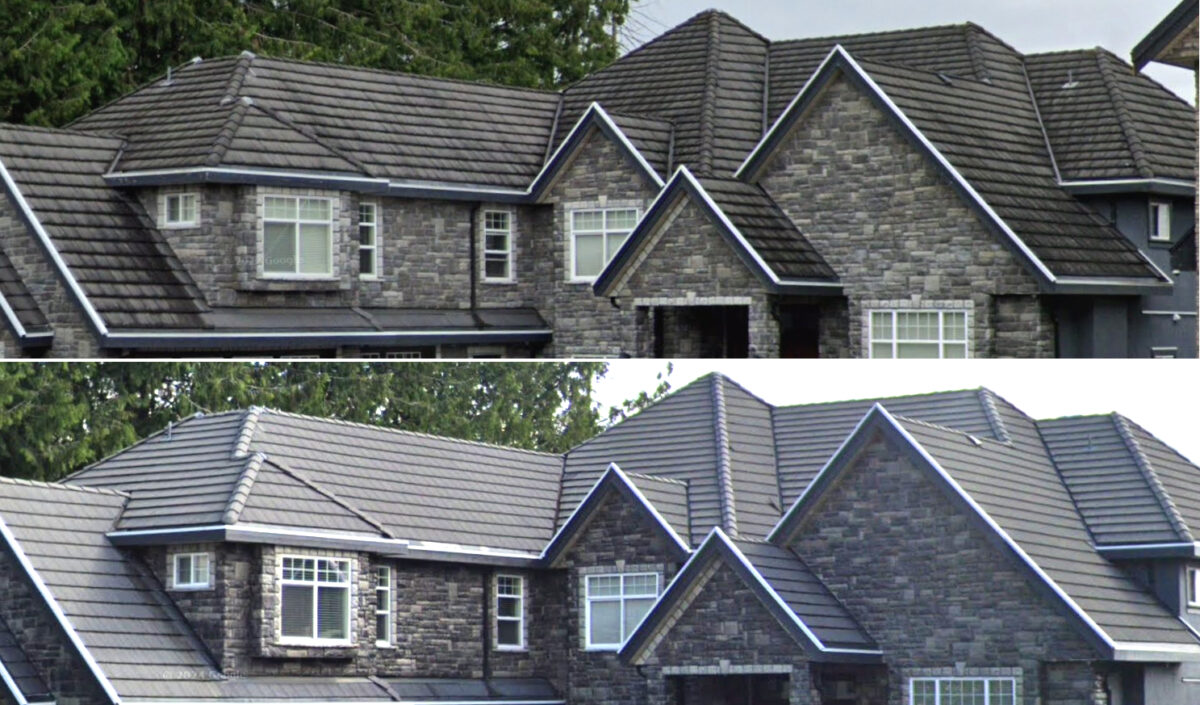
Search either term in Metro Vancouver and you’ll find companies using them to describe what looks like the same service. One company calls it roof washing, another calls it roof cleaning, a third calls it both. Homeowners comparing quotes reasonably wonder: are these actually different services? And does it matter which one I book?
The short answer: the terms overlap heavily, but they describe two distinct steps in the same process. Knowing the difference helps you confirm you’re getting a complete job — not just one half of it.
The Two Steps Hidden Inside a Full Roof Service
A thorough roof job in Metro Vancouver has two distinct parts:
- Physical clearing — removing the debris sitting on your roof: fir needles, alder leaves, dead moss clumps, and the buildup that packs into valleys and gutter lines.
- Chemical treatment (soft washing) — applying a low-pressure solution that kills the living organisms on the surface — moss, algae, and lichen — at the root level.
Some companies use “roof washing” to mean only the chemical step. Others use “roof cleaning” to mean only the physical step. Many use both terms for the whole job. This inconsistency is exactly why the terminology confuses homeowners — and why it matters to ask specifically what a quote includes before you book.
What “Roof Washing” Usually Means
When a company advertises roof washing, they typically mean a soft-wash treatment: a solution applied at low pressure that penetrates moss, lichen, and algae and kills the organism at its root. The treatment does not scrub moss off the surface immediately — it kills it in place. Over the following weeks, rain gradually rinses the dead material away.
Soft washing is the correct method for asphalt shingles. High-pressure washing strips the ceramic granules off shingle surfaces — the granules that protect against UV and water — and can void your manufacturer warranty. If any company quotes you “pressure washing your asphalt roof,” that is a significant red flag.
What “Roof Cleaning” Usually Means
In the physical sense, roof cleaning refers to the manual removal of debris: sweeping or blowing fir needles and leaves off the surface, hand-clearing the valleys where buildup packs in hardest, and pulling accumulated material out of the gutter line.
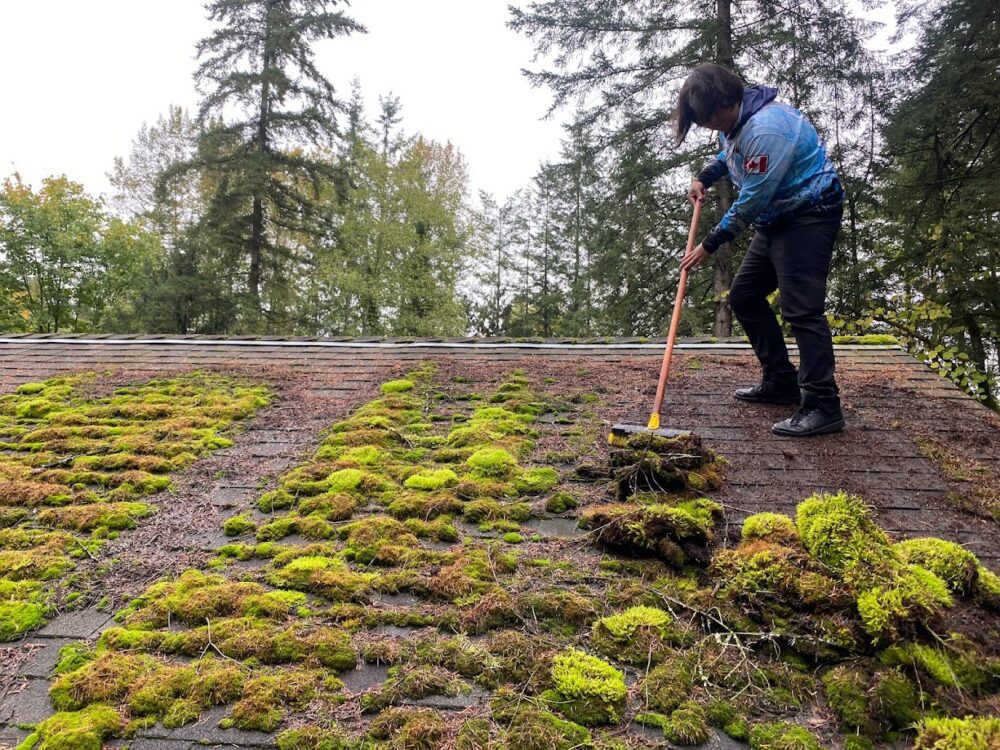
In Metro Vancouver, this step matters more than most homeowners realize. Douglas fir and western red cedar drop needles continuously. Those needles trap moisture against the shingle surface, and that retained moisture is what accelerates moss and lichen growth. Even after a soft-wash treatment kills existing moss, a roof still buried under a layer of needle debris will re-colonize far faster than a cleared one.
Physical clearing is also the most labour-intensive part of the job — which is why roof cleaning costs more than it looks like it should from the ground. Clearing valleys, walking the ridgeline, bagging debris, and flushing the gutters takes most of the time on site.
Why Metro Vancouver Roofs Need Both Steps Together
The region’s climate creates a two-layer problem. The debris problem — fir and cedar needles — is constant and year-round, worsening through fall. The biological growth problem — moss, algae, black lichen — accelerates through the wet season from October through April, when roofs stay damp for weeks at a stretch.
Treating with chemicals but skipping the physical clear leaves the root cause in place. The treatment kills what’s there, but a roof still buried in debris will re-infest within a season or two. Clearing the debris but skipping the treatment leaves living moss roots in the shingles — it looks better immediately but grows back within months.
A complete service does both: clear the surface first, then treat the growth. Many companies also flush the gutters as part of the same visit, which makes sense because debris cleared from the roof ends up there. If you’re separating services, gutter cleaning should follow the roof work, not precede it.
The Prevention Step Most Services Skip
After clearing and treating, the most effective addition is a zinc or copper strip installed along the ridge. Every time it rains, metal ions run down the roof surface, creating an environment where moss and lichen struggle to take hold. A treated roof with a ridge strip stays cleaner significantly longer than one without.

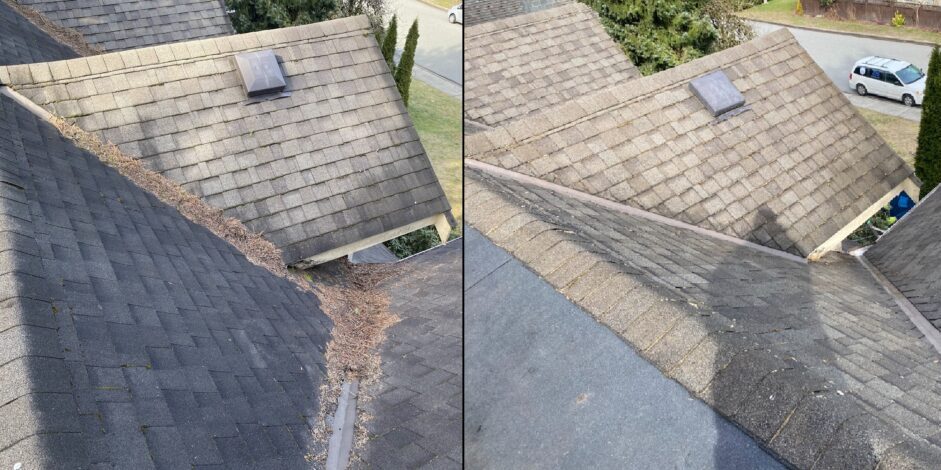
The photo above shows a roof mid-treatment: the brighter upper shingles have received the zinc-based solution; the darker lower shingles have not yet. After a few weeks, the colour evens out as rain dilutes and spreads the treatment. The visual difference during the job is one of the clearest ways to confirm the treatment has actually been applied.
Different Roof Materials, Different Rules
Everything above applies primarily to asphalt shingles, which cover the majority of homes in Surrey, Langley, Abbotsford, Maple Ridge, and across the Fraser Valley. Other materials require adjustments:
- Concrete or clay tile roofs can tolerate low-pressure rinsing in addition to chemical treatment, since the surface is harder and less granule-dependent.
- Metal roofs (corrugated, standing seam) handle slightly higher pressure without damage and can be rinsed more aggressively than asphalt.
- Cedar shake roofs require the gentlest approach of all — chemical treatment only, with careful hand-clearing. The wood surface is soft and splits under mechanical pressure.
What to Ask Before Booking a Roof Cleaning Service
When comparing quotes, these questions separate a complete service from a partial one:
- Is debris removal included? Some companies quote the chemical treatment only. If your roof has visible needle or moss buildup, confirm physical clearing is part of the price.
- Soft wash or pressure wash? For asphalt and composite shingles, the answer should always be soft wash. Pressure washing is appropriate only for metal roofs and some tile applications.
- Are workers harnessed? Roof work without fall protection is a liability risk for you as the homeowner. Ask about WorkSafeBC coverage and whether workers anchor from the ridge.
- Are gutters flushed afterward? Debris cleared from the roof surface goes somewhere. Confirm the gutters are flushed before the crew leaves.
- Is a prevention strip available? A zinc or copper ridge strip is the most effective way to extend the time between service calls. Not every homeowner wants it, but it should be offered.
Frequently Asked Questions
Is roof washing the same as roof cleaning?
Often, yes — many companies use the terms interchangeably to mean the full job. But not always. Roof washing can refer specifically to the chemical soft-wash treatment, while roof cleaning can refer specifically to the physical debris removal. When booking, confirm both steps are included if your roof has visible moss growth and debris buildup rather than assuming the quote covers everything.
Should roof cleaning and gutter cleaning be done at the same visit?
Yes, with roof work first. The debris cleared off the roof ends up in the gutters, so cleaning the gutters after the roof work is the logical sequence. Cleaning gutters first and then clearing the roof means cleaning them twice.
How long does it take for moss to fall off after a soft-wash treatment?
The treatment kills moss within a few days, but the dead material does not disappear immediately. Rain washes it away gradually over four to eight weeks depending on rainfall volume and how thick the moss was. The roof will not look dramatically cleaner the day of service — that is normal and expected with soft washing. The result becomes visible over the following month.
Does the roof cleaning solution affect surrounding plants?
A reputable roof cleaning service will pre-soak all plants and shrubs below the roofline with water before applying any solution, then rinse them again thoroughly after the work is complete. Ask your provider what their plant protection protocol is before they begin. If they do not have one, that is worth knowing in advance.
Ready to book a professional roof cleaning or soft-wash service for your Metro Vancouver home? Get a fast quote here — we serve Surrey, Langley, Abbotsford, Maple Ridge, New Westminster, and the surrounding area.