





If your driveway looks like the forest floor every spring — green, slippery, and somehow worse than it looked last fall — you’re not imagining it. Metro Vancouver driveways turn green on a predictable annual cycle, and the same conditions that cause it ensure it always comes back. Here’s why it keeps happening and what actually works to break the pattern.
What Is Actually Growing on Your Driveway
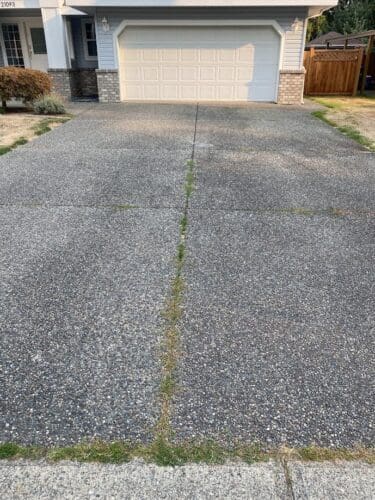
The green film on Metro Vancouver driveways is almost always a combination of three things: algae, moss, and sometimes lichen. Algae arrives first — it’s microscopic, it spreads through the air, and it only needs moisture and a rough surface to take hold. Once algae colonizes the texture of your concrete or pavers, moss follows. Moss roots slightly deeper, holds water, and creates the ideal seedbed for more growth. Lichen is slower but tougher — once it attaches, it physically etches into the surface material itself.
On standard concrete driveways, you typically see a green algae film first, then a darker green-to-grey creep as moss establishes. On exposed-aggregate and paver driveways, the gaps between stones collect organic debris and stay wet longer, so growth is heavier and spreads faster.
Why Metro Vancouver Is Ground Zero for Green Driveways
Three factors combine to make Metro Vancouver one of the worst places in Canada for driveway algae and moss:
- Rain for nearly eight months straight. Vancouver averages over 1,150 mm of rainfall per year, and Surrey, Burnaby, Langley, and Coquitlam are not far behind. Concrete and pavers stay wet for days or weeks at a time — exactly the conditions algae and moss need to establish and spread.
- Douglas-fir and western red cedar trees everywhere. Metro Vancouver’s urban canopy is dominated by these two species. Needle and seed debris settle into every textured surface, feeding algae colonies and retaining moisture long after the rain stops. If your driveway runs under or near a large fir or cedar, it will green up significantly faster than one in full sun.
- Mild winters that never freeze growth out. Unlike most of Canada, Metro Vancouver rarely gets hard freezes that would kill algae colonies outright. Growth slows in November but never fully dies — it waits for a warmer week, then picks right back up. By February the cycle is already accelerating again.
The result: a driveway that was clean last July can be visibly green by October and outright slippery by spring. And if you pressure wash it once without treating the surface, it will be just as green again within a year.
Why It Gets Worse Every Year You Leave It
Here is what most homeowners don’t realize: every season you leave algae and moss on concrete, they make it easier for the next generation to grow.
Algae and moss physically etch microscopic channels into concrete surfaces over time. They hold debris. They increase the surface area available for the next spore to land and attach. A brand-new driveway in Metro Vancouver might stay clean for two to three years. A driveway that has had moss growing for a decade can start looking dirty again within a few months of cleaning if the surface isn’t treated properly after washing.
The same principle applies to paver driveways. Once the joint material between pavers degrades from organic buildup and root pressure, weeds and grass establish in the gaps — and those gaps collect moisture that feeds more algae and moss on the surrounding surfaces.
The Slip Hazard Nobody Mentions
Green driveways aren’t just a cosmetic problem. Wet algae on concrete is genuinely slippery — the same organism that makes riverbanks treacherous underfoot does the same thing to a driveway surface. The risk is highest on sloped driveways, on steps, and in shaded areas that stay damp for hours after the rain stops.
This matters especially from October through April, when your driveway is wet nearly every morning. If your driveway has a gradient toward the garage or toward the street, algae growth creates a real fall hazard for anyone walking across it — including kids, older family members, and delivery drivers.
How Professional Driveway Cleaning Actually Works
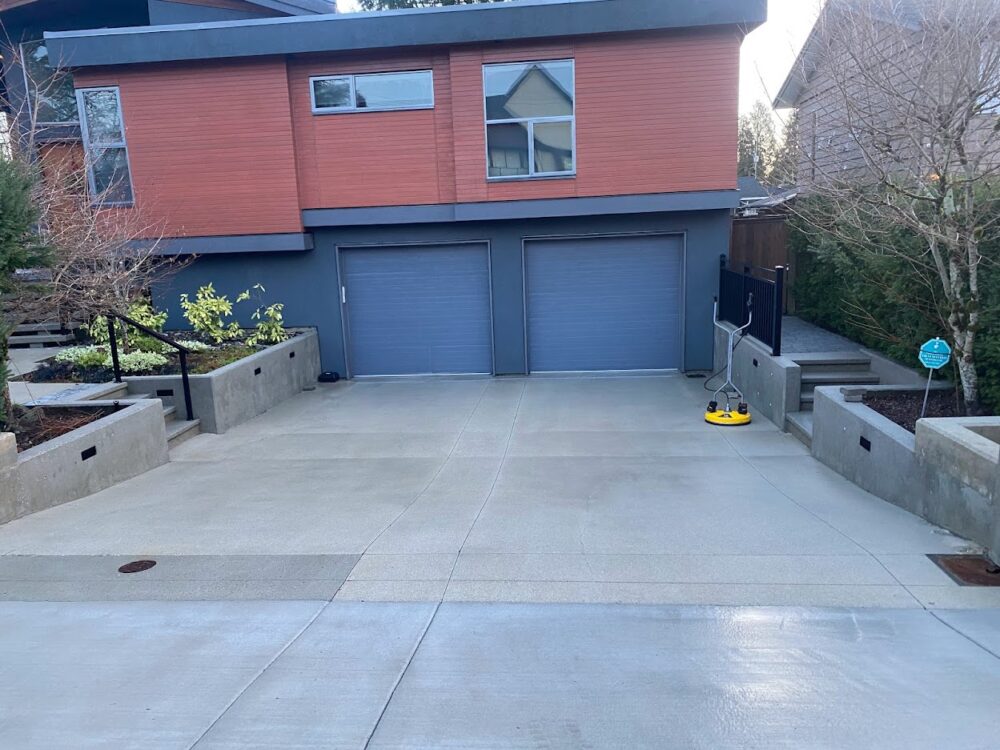
A proper driveway cleaning isn’t just a rinse with a pressure washer. The process that actually removes algae and prevents fast regrowth involves several specific steps:
- Surface cleaner attachment. A flat rotating head cleans evenly across the full width of the driveway without leaving the stripe marks a direct wand leaves behind. Uneven cleaning leaves bands of residual algae that regrow faster than the areas that were fully cleaned.
- Pre-treatment on heavy growth. For driveways with established moss or heavy algae, a pre-treatment application breaks down the growth before the main wash. We pre-soak any plants or lawn bordering the driveway with water before applying anything, and rinse them thoroughly again when the job is done.
- Edge and joint cleaning. On paver driveways, the gaps between pavers need specific attention that a surface cleaner alone won’t address. A detail nozzle clears what has built up in the joints and at the edges against the curb or lawn border.
- Post-clean treatment for longevity. Applying a treatment solution after cleaning kills residual spores and slows regrowth significantly. This is the step that separates a result that lasts 12 to 18 months from one that looks green again by fall.
For context on what professional pressure washing typically costs in Metro Vancouver, our pricing guide covers current rates and the factors that affect the final number.
How Often Should You Clean a Metro Vancouver Driveway
For most homes here, once every one to two years keeps driveways clean and prevents the heavy buildup that becomes harder and more expensive to remove. Homes under heavy fir or cedar canopy often need annual cleaning. Homes in full sun with good drainage can usually go two years between cleanings without significant buildup.
A practical rule of thumb: if you can see visible green patches by early spring, clean that year. If the surface still looks clean and doesn’t feel slippery when wet, you can safely push it another season.
Driveways aren’t the only surface that follows this pattern. The same climate that turns driveways green does the same to your home’s siding and — more seriously — your roof. If your driveway is overdue, the rest of the exterior almost certainly is too.

Frequently Asked Questions
Can I keep my driveway clean with a regular garden hose?
A garden hose doesn’t have enough pressure to break the bond between algae and concrete. It will rinse loose debris and dust but won’t remove established algae or moss. Those require at minimum a consumer-grade pressure washer, and for results that actually last, a surface cleaner attachment and a treatment applied after the wash.
Why does my neighbour’s driveway stay clean longer than mine?
Sun exposure is the biggest factor. Driveways in full sun dry out quickly after rain, which slows algae growth dramatically. If your driveway is shaded by a tree, a fence, or the house itself for most of the day, it stays wetter longer and will green up faster. Surface texture also plays a role — rougher concrete finishes and exposed aggregate hold more moisture and debris than smoother surfaces.
Will pressure washing damage my concrete driveway?
Done correctly, no. A surface cleaner at the right pressure cleans thoroughly without damaging the surface. The risk comes from using too high a pressure with a direct wand on older or spalling concrete — that can etch the surface or blast out loose aggregate. A professional adjusts the pressure to match the surface type and condition before starting.
Does cleaning actually slow down regrowth, or does the green come back just as fast?
Cleaning alone won’t significantly slow regrowth — algae spores are always present in Metro Vancouver’s air. Post-treatment after cleaning is what changes the timeline. The combination of proper cleaning plus treatment is what gives you 12 to 18 months or more instead of six. Zinc strips installed at the ridge of a nearby roof also help by washing a mild zinc solution down onto surfaces below every time it rains.
If your Metro Vancouver driveway is showing green, get a quote from Shine City. We serve Surrey, Burnaby, Langley, Coquitlam, Abbotsford, Richmond, and the surrounding communities — and we’ll tell you honestly whether your driveway needs a full treatment or a standard clean.